The truth about farmers’ markets (and why they’re worth it)
You’ve walked past the stalls. Maybe you’ve bought a bunch of carrots or a loaf of sourdough. But you’ve also probably wondered: Why does this tomato cost more than the one at Woolies? And is it actually better? Here are the honest answers.
How much fresher Is farmers’ market produce, really?
The short answer? Significantly. The longer answer involves understanding how supermarket supply chains work.
Most supermarket fruit and vegetables travel through a distribution network that can take anywhere from three days to three weeks from harvest to shelf. Produce is often picked before it’s fully ripe so it survives the journey. It is then artificially ripened with ethylene gas closer to its destination. By the time it reaches you, it may have spent time in cold storage, on a truck, in a warehouse, and then on a shelf.
At a farmers’ market, most growers harvest within 24 to 48 hours of the market. Some pick the morning of. Strawberries ripen on the plant. Stone fruit comes off the tree when it’s ready, not when it’s convenient for a logistics schedule.
This matters for more than flavour. Nutrient density drops after harvest. Some vitamins, particularly vitamin C and folate, begin to degrade within days of picking. A tomato that’s been in transit for two weeks is nutritionally a different food from one picked yesterday.
Why does it cost the same or more?
This is the question that makes people walk away without buying anything. It’s fair to ask.
The price premium at a farmers’ market reflects something the supermarket price deliberately hides – the true cost of production. Commercial agriculture achieves low prices through scale, mechanisation, long supply chains, and labour conditions and environmental externalities that are rarely factored into the sticker price.
Small-scale farmers can’t compete on volume. They’re often growing heritage or heirloom varieties that don’t travel well but taste extraordinary. They may be farming regeneratively, which is more expensive but better for soil health. They’re paying for their own stall, their own transport, their own time standing in a paddock at 5am.
What you’re paying for is the actual cost of growing food well. The supermarket price is, in many ways, a subsidised fiction.
How much more does a farmer make at a market?
This is where it gets interesting. A farmer selling directly to a consumer keeps roughly 80 to 90 cents of every dollar spent. Through a supermarket, that same farmer might receive 10 to 20 cents per dollar of retail price – sometimes less.
Supermarkets impose significant margin pressure on suppliers. They dictate pricing, demand cosmetic perfection (which means a large percentage of perfectly edible produce never leaves the farm), and can delist a supplier with little notice. For small growers especially, these terms are often take-it-or-leave-it.
A walnut grower who used to supply Woolies was a new face at a farmers’ market. She complained that the price the supermarket imposed didn’t even cover the cost of fertiliser and harvesting. The supermarket then sold those walnuts at 10 times the price paid to the farmer.
At a market, the relationship is direct. The grower sets the price, talks to the customer, and receives payment on the day. There’s no middleman, no distributor’s margin, no retailer’s cut. This is why many small farms that couldn’t survive selling to supermarkets are economically viable selling at markets.
How do farmers’ markets support local economies?
The economic impact is more significant than most people realise.
Money spent at a farmers’ market tends to circulate locally. A farmer from a nearby region spends their income at local businesses, employs local workers, and buys supplies from local providers. Research consistently shows that locally spent dollars have a higher multiplier effect. They turn over within the community more times before leaving it.
Farmers’ markets also support agricultural diversity. When consumers buy from a range of small producers, they help keep varied farming operations viable, which in turn preserves agricultural land, rural employment, and food system resilience. A region dependent on a single large-scale supplier is fragile. One with dozens of small producers is not.
And there’s the less quantifiable but very real social economy. The relationships between growers and eaters, the knowledge exchanged across a market stall, the trust built when you know exactly where your food came from and who grew it.
The farmers’ market tomato costs more because it’s a different product entirely – grown differently, harvested differently, sold differently. Whether that’s worth it is your call. But now at least you know what you’re actually comparing.
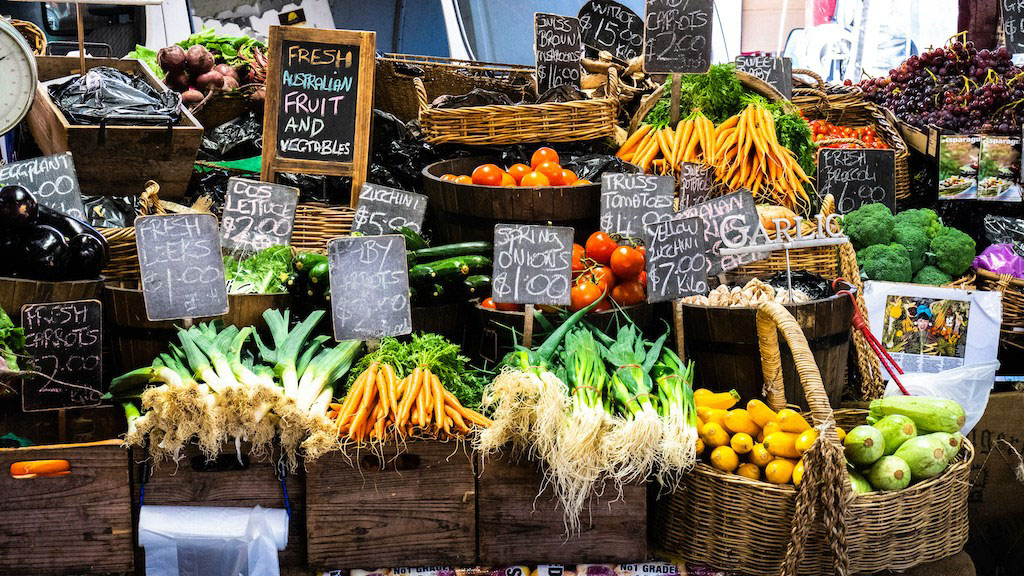
Photo by Somi Jaiswal via Unsplash